

Ethanol as an Industrial Carbon Sink
For years, the climate community has debated the exact boundaries of Carbon Dioxide Removal (CDR). While the fundamental goal of extracting legacy CO2 from the atmosphere and locking it away permanently is universally understood, the voluntary market has spent countless cycles arguing over which projects truly make the cut.
A frequent focal point in this debate has been the retrofitting of US corn ethanol plants with carbon capture and storage (CCS). Skeptics have historically pointed out that capturing fermentation exhaust doesn't suck carbon directly from the sky in real-time. But this view misses the biological reality: the drawdown happens upstream during the growth of the biomass itself. When an ethanol facility captures that biogenic CO2 before it can re-enter the atmosphere, it severs the natural carbon loop, effectively functioning as an industrial-scale carbon sink.
Instead of getting caught in endless semantic arguments over what constitutes "pure" CDR, pragmatic corporate buyers and project developers are shifting their focus to what actually moves the needle. Today, the most important questions driving investment are practical:
- Can this system scale in a net-zero economy?
- Can the entire lifecycle achieve net-negative emissions?
Crucially, can we rigorously quantify the impact without double-counting?
For the US ethanol industry, the answer is a resounding "yes." Every day, facilities naturally produce highly concentrated biogenic CO2 as a byproduct of the fermentation process. By capturing and permanently storing this gas safely underground, a process known as Bioenergy with Carbon Capture and Storage (BECCS), ethanol plants are uniquely positioned to become premier suppliers of these highly sought-after CDR credits.
But how exactly do you turn that captured gas into a premium, sellable carbon credit without running into regulatory red tape or accusations of greenwashing? The reality is that the market's rulebook is evolving right now. While brand-new, highly specific carbon methodologies tailored exclusively to the nuances of ethanol plants are actively being developed, producers absolutely do not have to wait on the sidelines. Broader, world-class carbon crediting frameworks already explicitly accept and outline the rules for ethanol BECCS projects.
By understanding these evolving frameworks and leaning into rigorous Life Cycle Assessment (LCA) and Measurement, Reporting, and Verification (MRV) standards, ethanol producers can unlock a lucrative carbon revenue stream alongside their fuel production with complete confidence and market backing.
The Science of True Removals: Why Ethanol Escapes the Double-Counting Trap
To understand why the carbon market is pivoting toward ethanol, we must look at the natural carbon cycle. Biomass, such as the corn used in US ethanol production, captures significant quantities of CO2 during photosynthesis. Historically, much of that captured carbon was released back into the atmosphere as a byproduct of the fermentation process.
Today, that fermentation exhaust is no longer a waste stream. It is a highly concentrated, easily capturable source of biogenic carbon. When an ethanol plant captures this CO2 and sequesters it permanently in a secure underground geological formation, it effectively reverses the carbon cycle. Because the carbon originated from the atmosphere and is locked away in the earth, it constitutes a true, negative-emission removal.
This distinction is crucial for monetization. Because these credits represent distinct, physical removals of carbon from the atmosphere, they can be clearly separated from the fuel itself. Provided the project rigorously adheres to registry rules to ensure the removal is not double-counted across multiple climate mitigation policies, ethanol plants can confidently sell these credits into the voluntary market while simultaneously optimising their carbon intensity for the federal 45Z Clean Fuel Production Credit.
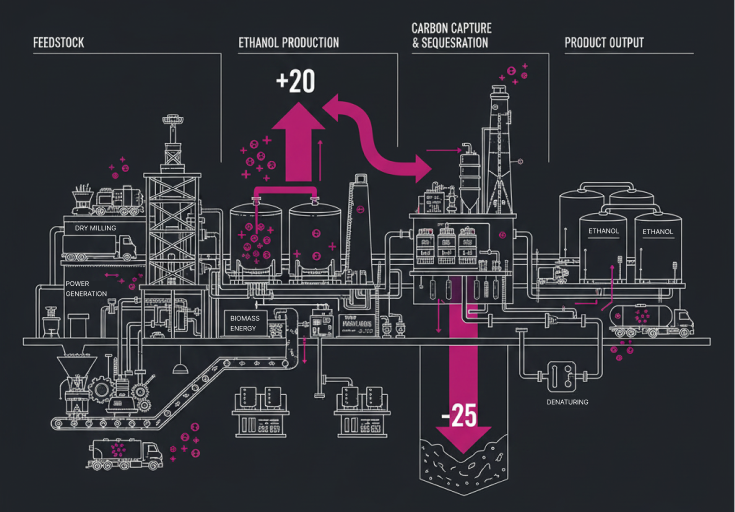
Source 1: Describes the carbon emissions and sequestration process in the ethanol plant, including details of the feedstock used, ethanol production, and the BECCS method applied to capture carbon generated during fermentation. It also accounts for CO₂ emissions resulting from transportation across the supply chain.
The Methodology Landscape: Broad Frameworks, Specific Solutions
While the market is still in its early stages and a singular "ethanol-only" finalised methodology does not yet exist, ethanol producers absolutely do not have to wait on the sidelines. Leading carbon standard bodies have developed broad, highly rigorous frameworks under which US ethanol plants can register today:
- Puro.earth’s Geologically Stored Carbon (GSC) Methodology: This framework governs the permanent storage of eligible CO2 streams, explicitly mandating that the carbon remain securely stored for at least 1,000 years. It explicitly validates biogenic CO2 captured from the biological treatment of biomass such as "alcoholic fermentation for ethanol + CCS" as an eligible source for Carbon Removal Certificates (CORCs).
- Gold Standard’s Biomass Fermentation with Geologic Storage (Currently in Public Consultation): Built specifically for activities where CO2 from biomass fermentation (like bioethanol production) is captured and permanently stored, this methodology is currently in the public consultation phase. It is shaping up to be one of the most stringent frameworks available. It mandates that projects deduct all project-related emissions (such as the energy used to capture, compress, and transport the CO2 and requires continuous, precise metering of fluid flow and composition. Crucially, to insure against the risk of future CO2 leaks, it requires projects to contribute a portion of their credits to a "buffer account" based on a comprehensive Non-Permanence Risk Rating Assessment.
- Isometric’s Biogenic Carbon Capture and Storage (Bio-CCS) Protocol: Isometric has established a highly rigorous protocol for durable carbon removal through Bio-CCS. Expanded to better accommodate point-source capture from eligible biomass feedstocks, it sets an incredibly high bar for MRV. It requires direct measurements to precisely calculate the biogenic share of the captured CO2 and ensures the geological storage mechanism provides greater than 1,000 years of durability.
- Verra’s CCS+ Framework (In-Development BECCS Modules): Under its Verified Carbon Standard (VCS) Program, Verra has published its overarching Carbon Capture and Storage methodology (VM0049), but the specific modules for Bioenergy with Carbon Capture and Storage (BECCS) are currently in development. Developed in collaboration with the CCS+ Initiative, these in-development modules will soon provide a flexible, high-integrity framework specifically for activities like ethanol CDR. Once finalized, they will outline the exact accounting rules to quantify removals from biomass point sources, further expanding the legitimate registry options for ethanol facilities.
All of these frameworks share a common, uncompromising baseline: they dictate that captured CO2 must be injected into secure underground formations and explicitly prohibit the CO2 from being used for Enhanced Oil Recovery (EOR). By aligning with these evolving standards today, ethanol producers can future-proof their operations and guarantee their credits meet the highest tiers of buyer scrutiny.
Addressing the Skepticism: The Power of MRV and LCA
These rigorous methodologies were not developed in a vacuum; they were designed to address valid historical skepticism. A few years ago, industry analysts correctly pointed out the risks of "hollow" ethanol carbon claims. The critique was simple: if a project ignores the massive upstream greenhouse gas emissions from corn farming, fertilizer application, and transport, claiming a net "carbon removal" at the smokestack is deeply misleading.
Today's standards have aggressively closed these loopholes. To mint a sellable credit, an ethanol plant must prove its operations are genuinely net-negative through undeniable data:
- Strict Life Cycle Assessment (LCA): Methodologies now require projects to deduct all total life cycle emissions arising from the whole supply chain. This includes accounting for emissions from the cultivation of biomass, processing, transportation, and even the embodied carbon of the newly built capture infrastructure.
- Uncompromising MRV (Measurement, Reporting, and Verification): To prevent any over-crediting, facilities must utilize continuous metering of the fluid composition and density. This requires taking measurements using highly calibrated equipment like gas chromatographs at a minimum of once every 15 minutes.
By leaning into these strict LCA and MRV requirements, ethanol plants completely neutralize past skepticism.
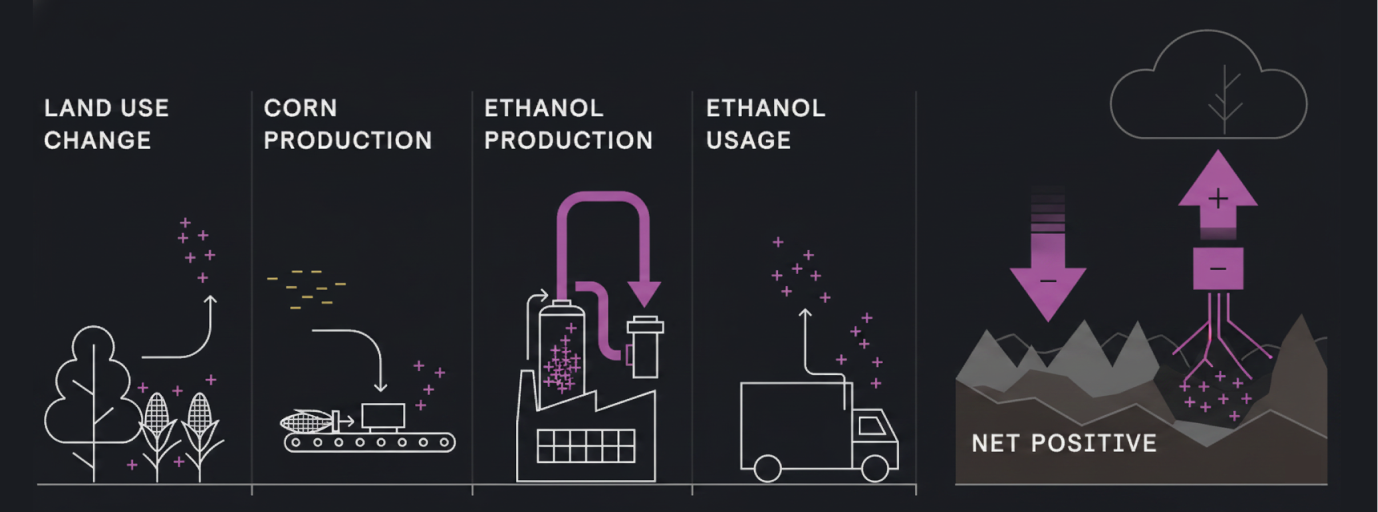
Source 2: Outlines the Life Cycle Assessment (LCA) of the ethanol-based BECCS project, quantifying both positive and negative emissions across the system. It also defines how dMRV ensures accurate monitoring, reporting, and verification of these emissions, supporting a clear determination of net carbon removal while preventing double counting.
Operationalizing the Data: The Need for a Premium Trust Layer
Understanding these dense methodologies is one thing; operationalizing them is another. Buyers are desperate for high-quality CDR, but they are terrified of reputational risk and greenwashing. On the other side, ethanol plants have the physical capability to capture carbon, but they need certainty that their massive capital expenditure will yield compliant, premium-priced credits.
To connect these two sides, the market requires an independent trust layer. This is the exact gap Vericap aims to fill acting as a bridge of diligence and data integration between the ethanol producer and the carbon buyer. Succeeding in this new market requires executing on three critical fronts:
- Project Readiness and Deep Diligence: Before a single credit is sold, a project must be fully market-ready. This means ensuring that a plant's MRV architecture and LCA calculations perfectly align with the complex requirements of overarching frameworks like Puro.earth and Gold Standard. Independent diligence ensures these systems are airtight from day one.
- Instilling Buyer Confidence: Corporate buyers need absolute confidence to transact at premium prices. When a project is vetted through an independent layer, buyers know the underlying data is unassailable. This protects them from greenwashing accusations and validates their investment in true carbon removals.
- Maximizing Total Value Across Markets: For ethanol producers, the operational burden of compliance is a major concern. However, the exact same granular LCA and continuous MRV logic required to mint a premium voluntary carbon credit is exactly what dictates a facility's Carbon Intensity (CI) score for the US 45Z tax credit. Running two separate data-gathering and compliance efforts is highly inefficient. By using the exact same underlying logic and data architecture to satisfy both federal tax requirements and voluntary standard bodies, platforms like Vericap drastically streamline the process. This unified approach ensures an ethanol plant extracts maximum financial value from both avenues without doubling the workload or risking double-counting.
The 2030 climate mandate has created a massive market for high-quality carbon removals. By prioritizing rigorous data integration and relying on platforms like Vericap to establish that essential layer of trust, US ethanol plants are perfectly positioned to move beyond the hype and lead the next frontier of the carbon economy.